The office isn't dead — it's being redefined

Business Forum
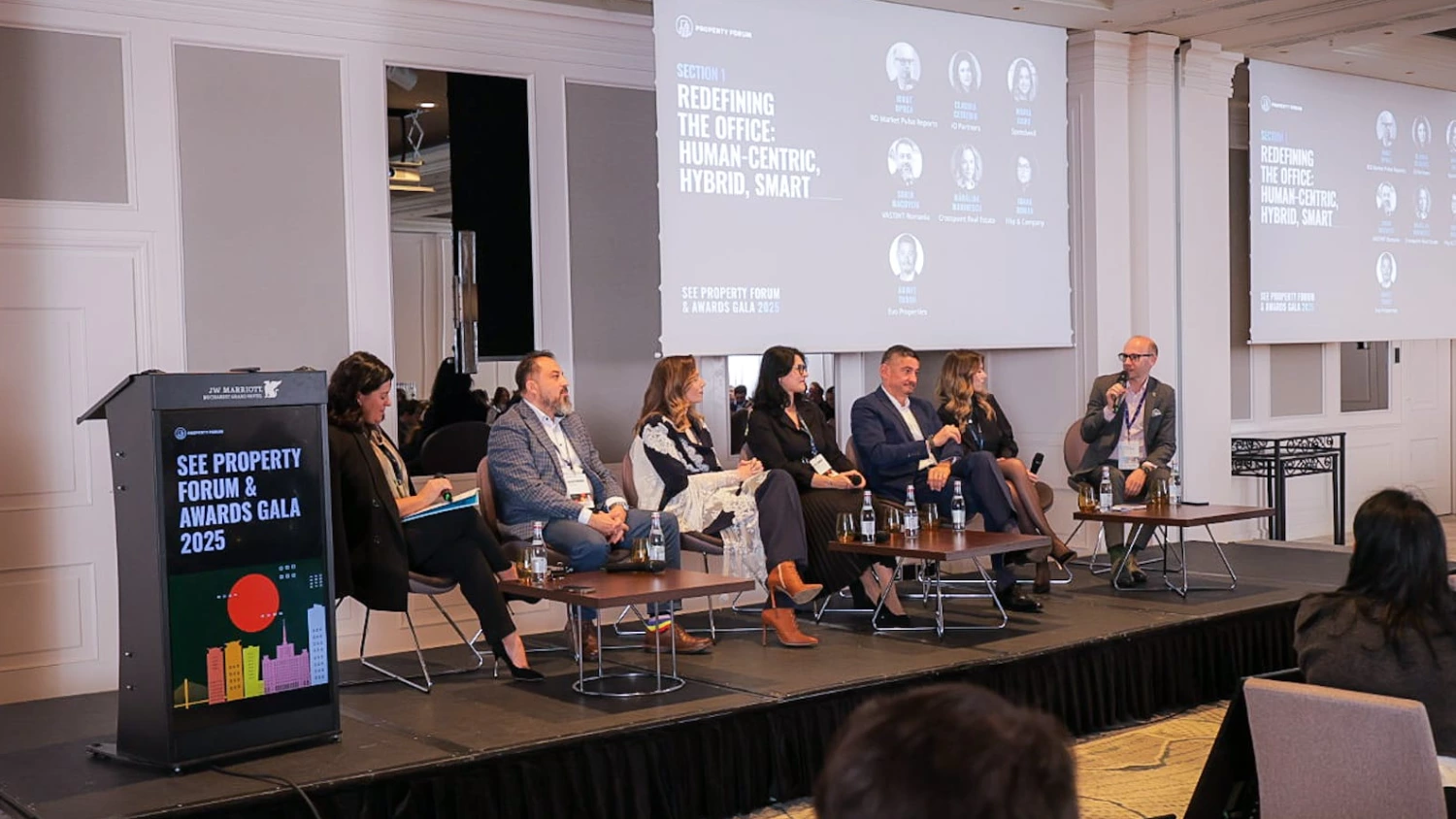
At our annual SEE Property Forum 2025 in Bucharest, seasoned market professionals gathered to dissect the rapidly changing landscape of office real estate. Moderated by Ionut Oprea, the conversation brought together a dynamic roster of experts: Claudia Cetățoiu (iO Partners), Maria Jianu (Speedwell), Sorin Macoveiu (VASTINT Romania), Mădălina Marinescu (Crosspoint Real Estate), Ioana Roman (Filip & Company), and Adinel Tudor (Evo Properties).

Kicking off the session, Oprea emphasised the magnitude of transformation in European office markets. "As we look at the evolution of office space, it is increasingly clear that every real estate asset must now have a compelling purpose," he stated. "In today's world, it's not just about maximising space, but about defining strategic value for people, communities, and investment."

Participants echoed these themes in their introductions and reflections on post-pandemic office environments. Claudia Cetățoiu urged the audience to reframe the return-to-office conversation, explaining, “The fundamental question has shifted from ‘How do we bring people back?' to ‘How do we inspire employees to return naturally?' True relevance in office design now lies in fostering connection, comfort, and choice. An office must encourage meaningful interaction, provide ergonomic and sensory comfort, and offer diverse workspaces that match varied tasks and personalities.”

Maria Jianu, reflecting on both her personal experience and market observations, highlighted the evolving expectations of office users. “I now see my workspace as a genuine service, even a gift, designed to enable maximum efficiency and personal well-being. What truly transforms the office is not only the greenery outside my window, but also the ‘circulation of information' and the many spontaneous interactions that catalyse onboarding and productivity.”

For Sorin Macoveiu, the office remains indispensable for its social and practical benefits. “Being in the office is first and foremost about the people—those real, daily connections that can't be replicated virtually,” he said. “When everything simply functions as it should, and you feel truly comfortable, the office becomes the zone of concentration and innovation. Ultimately, it allows me to draw a clear line between professional and personal life.”

Mădălina Marinescu described the office as a space of joy and cohesion: “For me, the office is an environment where vibrant collegiality and connection thrive. The forced separation during the pandemic made me appreciate even more the power of teamwork and the irreplaceable energy of in-person interaction.”

Ioana Roman provided a legal perspective, stressing routine and mentorship. “Being physically present is critical for nurturing the next generation of professionals; it simply cannot be replicated through Teams or Zoom,” she asserted. “Despite the comfort and amenities offices now offer, the biggest challenge remains accessibility; long commutes stand as major deterrents for talent returning full-time.”

Adinel Tudor, as a relative newcomer, saw opportunity in disruption. “Entering the market allows us to embrace honesty and experimentation, thriving on the ability to view and do things differently,” he remarked. “The essential elements—strong teams, great amenities, and an office with soul—are what create loyalty and innovation.”

As the conversation shifted to tenant demand and market evolution, panellists observed that demand patterns were becoming more sophisticated and forward-thinking. Jianu noted, “There's a distinct move from reactive to proactive portfolio strategies, with tenants seeking flexible, tech-enabled, and ESG-compliant spaces.” Macoveiu and Marinescu discussed the role of regional variance and the adjustments in leasing tactics, while Cetățoiu added, “It's not about downsizing, but right-sizing—making every square meter count more than ever for value, flexibility, and purpose.”

The road ahead, speakers agreed, will depend not only on market signals but on policy, infrastructure, and the will to innovate. “If Bucharest and our sector are to thrive, we must advocate for better infrastructure, smarter capital, and a genuine dialogue between developers, authorities, and communities,” Oprea concluded. “By embracing flexibility and catering to human experience, we are redefining the future office—not as a relic, but as a resilient, evolving asset.”

The discussion underscored a consensus: the office is far from obsolete. Instead, it stands on the verge of a new era—one constructed not just with bricks and beams, but with intention, adaptability, and people at its core.

RECOMMENDED
From uncertainty to opportunity: Whats driving Romanias new wave of residential growth?
Real estate

From uncertainty to opportunity: What's driving Romania's new wave of residential growth?

At the SEE Property Forum 2025 in Bucharest, leading voices from Romania's residential real estate sector came together to shed light on how developers, investors, and buyers are adapting to a period of economic uncertainty, rising construction costs, and shifting consumer priorities. From the growing appeal of build-to-rent and integrated communities to the urgent need for regulatory reform, the panel offered a forward-looking view of a market that is evolving rapidly yet remains defined by strong fundamentals and an enduring demand for quality homes.

The future of retail is about belonging, not just buying
Real estate

The future of retail is about belonging, not just buying

Once considered a purely transactional asset class, retail in CEE is rapidly evolving into a platform for experience, community, and brand identity. This shift was at the centre of the discussion at SEE Property Forum 2025, where industry leaders explored how shopping centres are adapting to changing consumer expectations, ESG requirements, and the growing demand for meaningful, multi-use spaces. 

Why the future of real estate starts with people, not technology
Real estate

Why the future of real estate starts with people, not technology

At SEE Property Forum 2025, the conversation around the future of real estate took a bold turn — from smart buildings to smart relationships. Industry leaders agreed that while data, automation, and ESG strategies are reshaping commercial real estate, true innovation begins with understanding people. The discussion, moderated by Vessela Valtcheva-McGee of GBCI Europe, explored how developers, investors, and service providers are using technology not just to optimise buildings, but to redefine how tenants experience and value them.

Employers want support for personal and professional growth
Real estate

Employers want support for personal and professional growth

Nearly 60% of Romanian employees believe their employers should do more to support both professional and personal development, according to a survey conducted by Genesis Property in the first half of 2025 on a nationally representative sample of 1,012 respondents.

Praktiker Real Estate buys office building in Bucharest
Real estate

Praktiker Real Estate buys office building in Bucharest

Praktiker Real Estate, the property company owned by Turkish investor Omer Susli, has purchased the Muntenia Business Center offices, in central Bucharest, from Longshield Investment Group for €8 million.

Residential developers need to be flexible
Real estate

Residential developers need to be flexible

The Romanian residential market is navigating through many changes. This means that developers need to be flexible in order to adapt to all changes, as the speakers of the residential panel of SEE Property Forum 2024 concluded.

RECOMMENDED FROM THE HOME PAGE
Energy

EBRD backs solar plants in Romania with €192 million package

The European Bank for Reconstruction and Development (EBRD) is supporting Romania's energy security by arranging a €192 million financing package for three new solar power plants of Nofar Energy, with a total installed capacity of 531 MW in south-eastern Romania.

Economy

Romania's budget deficit drops to 5.72% on 10 months

Romania's consolidated general budget recorded a deficit of €21.8 billion (RON 108.87 billion) in the first ten months of 2025, representing 5.72% of GDP. This marks a decrease of €110 million compared to the same period in 2024, when the deficit stood at 6.22% of GDP.  

READ MORE
Business Forum  |  2 December, 2025 at 5:08 PM
Business Forum  |  2 December, 2025 at 3:57 PM